
Skin Cancer Help Sheet
Important
If the Spotscreen practitioner has recommended that you follow up with your Doctor or other specialist health care provider it is to ensure that any suspicious lesions are properly diagnosed and if necessary, treated within a safe time frame.
It is imperative for you to follow the screening practitioner’s advice and see your GP within the time frame noted on the form sent to you via email.
If you notice any suspicious changes, including persistent itching or spot bleeding to any mole, lesion or ‘spot’ on your body, you must see your Doctor immediately.
What is Skin Cancer?
Skin cancer is a general term which encompasses all cancers which form in different cells of the skin. It affects hundreds of thousands of people living in Australia every year.
The most frequently diagnosed skin damage and cancers caused by ultraviolet (UV) radiation are melanoma, basal cell carcinoma, squamous cell carcinoma and solar keratosis.
Causes of Skin Cancer
Skin cancer is the result of cells becoming damaged through overexposure to UV radiation, predominately from the sun.
Studies also show that tanning beds increase the risk of skin cancer.
In some circumstances, melanoma can be linked to a genetic trait. If you have a direct family member who has had a melanoma you may be at greater risk of developing one.
How to Protect Yourself
It is important that you protect your skin while you are exposed to UV radiation and there are several ways you can do this.
A broad spectrum sunscreen which filters both UVA and UVB radiation is essential.
Unfortunately there is no ‘one size fits all’ product so please review the labels to select a sunscreen that is best suited to your working or leisure environment.
For small areas like the nose, ears and lips a zinc oxide based product is preferable.
You should protect your head and face with a wide brimmed hat as a cap only provides shade to the eyes, not the nose, face or ears.
Did you know?
The simple act of moisturising skin nightly and using a good sunscreen daily has the ability to effectively reduced solar keratosis by 70%! Not only are you reducing the risk of skin cancer but you are also reducing the effects of ageing!
Sunglasses that meet current Australian Standards should be worn to protect your eyes from sun damage.
Whenever possible long clothing should be worn to protect exposed skin from UV radiation. Shirts should be buttoned up to the neckline and when wearing polo shirts in the sun pull up collars to protect your neck.
For added protection driving gloves can be worn in the car to protect hands and forearms from direct and reflected UV rays coming through the windscreen.
Simple interventions made now can save a lifetime of skin cancer problems in the future.
ABCDE Symptoms to Look For!
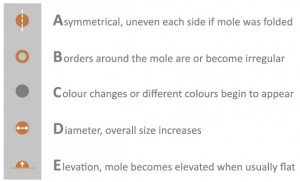
Any spots with these changes will require swift intervention. See your Doctor straight away. With early detection melanoma has a 95% cure rate. Treatment involves complete surgical removal of all traces of the melanoma from the skin.
Types of Skin Cancer
‘Solar’ Keratosis (Pre-cancer)
These are common in outdoor workers and have the potential to form SCC in the future.
They are easily managed and treated if identified in the early stages. It usually presents as pink or brown scaly patches which are sometimes itchy.
Basal Cell Carcinoma (BCC)
This is the most common type of skin cancer and can result in severe damage to the skin and structures such as ears, nose and eyes.
BCC symptoms can include:
- Pearly coloured lump
- Raised blister like lesion
- Scaly crater like non-healing sore
Squamous Cell Carcinoma (SCC)
This is the second most common type of skin cancer. Caused by excessive UV exposure SCC can be life threatening if left untreated over time.
SCC symptoms can include:
- A firm red nodule
- A flat lesion with a scaly crust
- New ulceration that fails to heal in one month
- A non-healing ulcer like sore on lip
Melanoma
Melanoma is the least common but most deadly form of skin cancer which develops in the skin’s pigment cells (melanocytes). They will often display one or more of the above ABCDE symptoms which require prompt assessment by your Doctor.